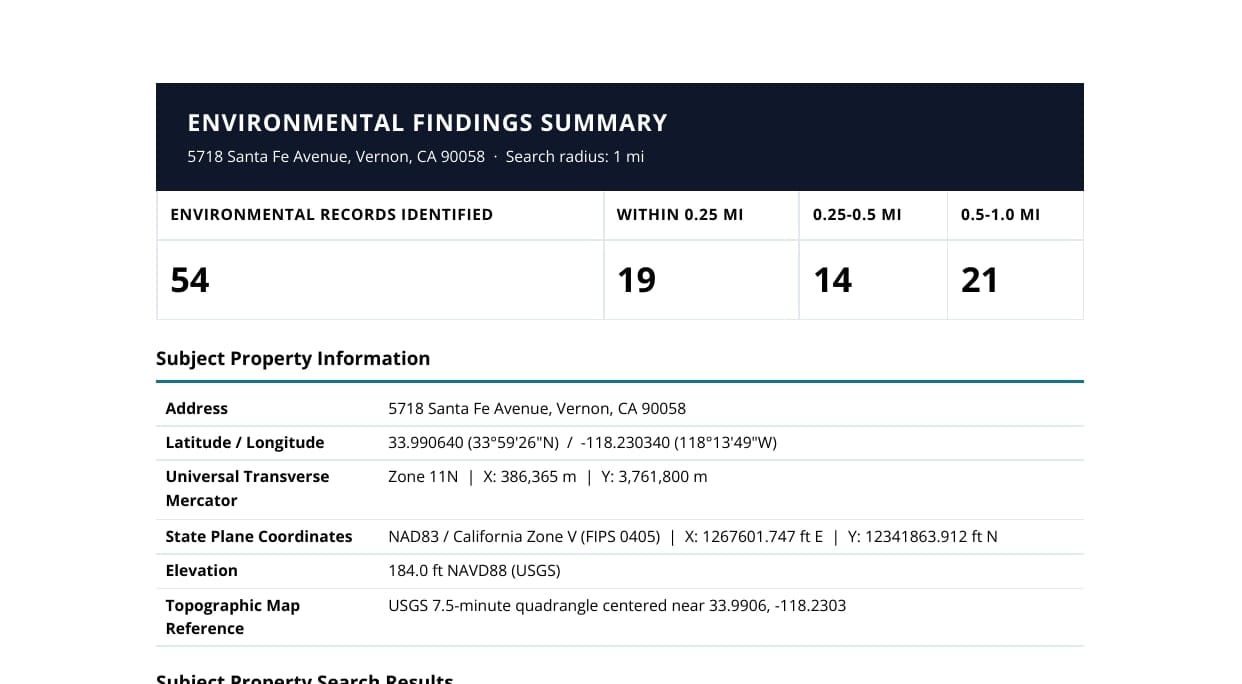
Findings summary from the Geoscope sample report: record counts by distance.
Before you make an offer
Define the purpose. Decide whether you need liability protection under CERCLA, lender-required reporting, or an early read on risk. The answer shapes which report you order.
Run a records search on the address. A mapped records report shows nearby regulated facilities, cleanup sites, tanks and other listings, with the status each database reports. It is a quick way to see whether the property or its neighbors raise questions.
Note the flood zone. A flood zone designation affects insurance and financing. Check it with the records.
During the due diligence period
Request prior reports from the seller. Ask for earlier Phase I or Phase II reports, tank closure documents, cleanup letters and any notices from regulators.
Ask about past uses. Gas station, dry cleaner, manufacturing, auto repair, farm, landfill or fill material on or near the site each prompt different follow-up.
Review the records that appear. For each, read the status, what was released or regulated, how far it is from the property, and what the source says about closure.
Decide on a Phase I ESA. If the buyer wants liability protection or the lender requires it, commission a Phase I from a qualified environmental professional. Time it to the closing, because of the date limits described in our article on how long a Phase I ESA stays valid.
Check for liens and land use restrictions. Environmental cleanup liens and activity and use limitations (also called institutional controls) can restrict what the owner may do. Your attorney and title company can search for them.
Ask about vapor. If solvent or petroleum sources are close, ask whether vapor screening is warranted.
Consider the sensitive locations nearby. Schools, hospitals and wells can change how regulators treat a nearby site.
Before closing
Confirm the report dates. Make sure the report components are within the time limits that apply to the law and to the lender.
Understand the continuing obligations. Liability protection depends on actions after closing as well. Your attorney can explain them.
Record what you relied on. Keep copies of the reports and records you used, with their dates.
Where Geoscope fits
A Geoscope report covers step 2 and helps with steps 6, 9 and 10. It is a mapped records report built from public government databases and third-party data sources, reviewed by an analyst. It is not a Phase I ESA, it does not include a site visit or interviews, and it does not replace advice from an environmental professional or an attorney.
This checklist is general information, not legal advice.
A Geoscope Government Records Report is your fast first step: database screening across 1,500+ sources, GIS-mapped results, delivered in 24 hours for $79.